Method
A system’s
drilling data can be described by creating a semantic map which is easily
transferred into machine readable code.
The semantic model is structured with a subject, a verb
and an object.
Example:
<DHPress, HasType, DownholePressure>
<DHPress, HasUnit, Pascal>
<DHPress, IsLocatedAt, PWD>
The
committee began by reviewing various user stories to develop various use cases in
need of a common interface. Semantic
maps were then generated. The work
product lists all the inputs and outputs identified by the committee. Of course, this is not an exhaustive
list. It is expected that various data
suppliers and users will notify the committee of additions. Updates will be posted routinely to inform
the industry.
Two
different types of semantic maps were developed to visualize the information. The first is a hierarchical map that shows a
basic flow between elements that can be used to describe data. The second is a logical map showing the
relationship using a verb to refine the description. The logical map adds the verbs that provide
richness to the description.
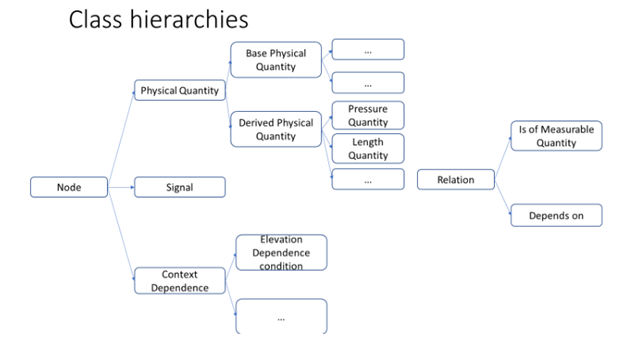
Figure 8 Example -Hierarchical Map

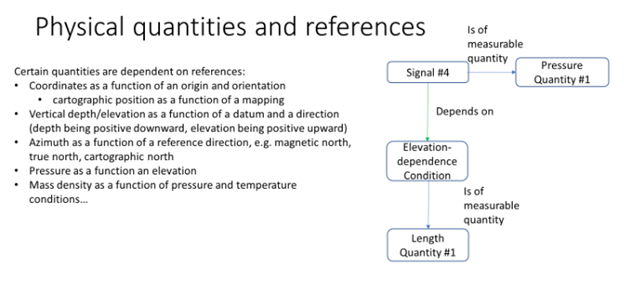
Figure 9 Example - Logical Map
The noun descriptors
begin with naming a class. In
computer science, and more specifically in object-oriented programming (OOP),
entities that share the same properties and behavior, i.e.
functions or procedures (also called methods), are described by a class. A
class defines properties and methods that are common to a group of objects
[Cayeux, 2019]. There may or may not be
sub-classes. A given class can only be a
sub-class of a single parent class. This defines a directed hierarchical structure
of classes. A list of common nouns for classes is included
in the Work Product chapter below.
An example
of class is "Physical Quantity" followed by typical verbs and
objects. We can start with Figure 10: Description of
“Physical Quantities” that provides a simple description
of various physical characteristics for of the class.
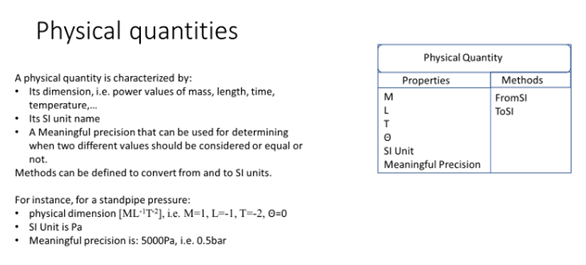
Figure 10: Description of “Physical Quantities”
Next, we
can visualize these characteritics hierarachically as shown in Figure 11: Hierarchical Map of
"Physical Quantities".
These are the base quantities and derived quantities, and we can see how
these can be measured and expressed using the noun-verb-object notation.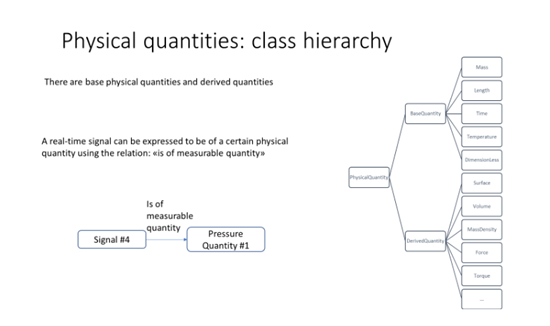
Figure 11:
Hierarchical Map of "Physical Quantities"
Finally, we
can add the verbs to produce a logical map.
See Figure 12.
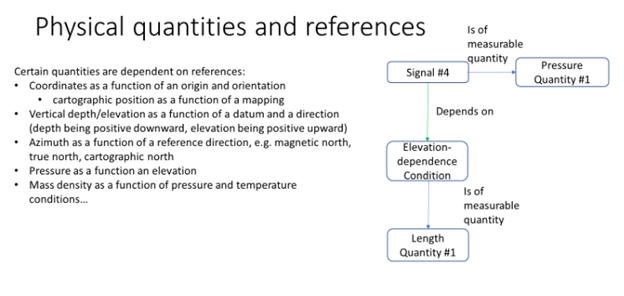
Figure 12: Logical Map of
"Physical Quantities"
Thus the
Physical Quantity is a Base Quantity of Mass, Length, etc., or the Physical
Quantity is a Derived Quantity using Mass Density ,
Force, etc. that can be identified and expressed semantically.
Through
this example, we have described two signals that share the same physical
quantities and yet, have two very different meanings, one being a physical
property of a material while the other is a pressure gradient.
From these
relatively simple descriptions, they can be nested or expanded as necessary and
can even reveal context dependence.
Nodes and branches can be added enhance the logical map with descriptive
verbs between the two nouns. Thus, a
semantic network consisting of nodes and relations can be expressed as node1
has a relationship1 with node2. A complex model can be described using nodes
and relationships such as shown in Figure 13: Nodes and Relationships.
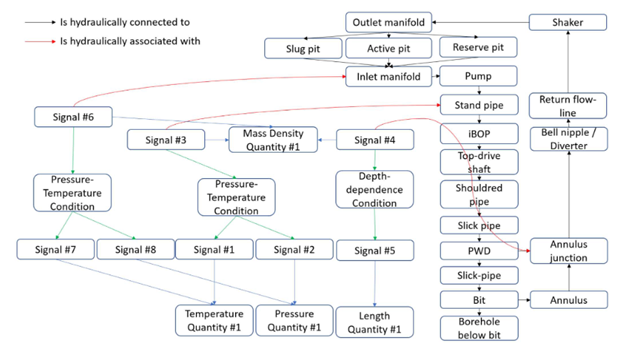
Figure 13: Nodes
and Relationships
Hydraulic
logical elements are linked together using relations of the type "Is
hydraulically connected to". Furthermore, a signal can be associated with
a hydraulic logical element using a relation of the type "Is hydraulically
associated to."
There are
specific groupings of the elements above that facilitate creating the
description of each element. These are
shown in the following charts. In
addition, all the nouns and verbs currently identified are listed below in
alphabetical order. Of course, new
elements can be introduced. We ask that
you notify the workgroup so that we can update the list to share with others.