Overall Description
The current
method of managing drilling signals across data suppliers and data consumers
during drilling operations requires perfectly aligned tag names as well as
communication protocols. Work Group 1 is
tasked with developing a plug and play methodology that does not require human
interface to match tag names. Others are
working on standardizing communication protocols.
Using a
semantic process, each machine/sensor or other element describes itself (what
it is and what it can
do) and provides this as real time information.
[Cayeux, 2019] This
allows adding and removing devices from a rig network without affecting
existing devices. The description of
every device shall be agreed beforehand using techniques based on the output of
this committee; namely by describing itself as interrelated “facts” of the form
Subject – Verb – Object. This creates a
semantic network containing the topological relationship between each device or
element that can be used to generate computer code to bridge between various
participants devices/elements. However,
new device names may be added at any time ...
Note that
the devices/elements could be hardware, like a controller or a sensor, or it
could be a computation, an estimate, or non-structured data such as a typed
report. An application that needs to
access information can query the semantic network for the signals that match
certain criteria. When the elements are
properly described, an application can understand the data, how and where it is
obtained and other metadata.
Furthermore, this metadata is stored along with the data for use in the
future should users need to reexamine the data years later.
This allows
drilling automation systems to:
· Discover and select required data, without prior knowledge of the rig signal set-up
o Get access to all the necessary information about the data
o Automatically configure the data transfer
· Get informed when rig signal set-up is modified
o Reconfigure itself
· Provide information about its own data
o Can be used by other systems
There are
some basic definitions that help explain the nature of this project.
The
SPE-subcommittee “Drilling Data Quality
and Uncertainty” has assembled a list of user cases / user pain points and
has begun to examine each in detail. The
work is currently incomplete and ongoing.
This document will be updated periodically as additional items are
examined.
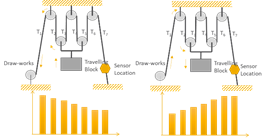

Example:
abnormal low hook-load detection and characterization
Scenario: A
simple quick drilling event detection application focused on abnormal low
hook-load would utilize semantic information.
Context:
•
The
application can detect an abnormal low hook-load with regards to a threshold
•
If
there is sufficient information, it can categorize the event between a ledge or
a pack-off
•
The
application should be able to distinguish an event from routine variations in
hook load due to sheave friction.
Capability:
•
It
can make use of:
•
Block
position, bit depth, bottom hole depth
•
Several
variants of hook-loads
•
Top-drive
speed and torque
•
Flowrate
and SPP
•
Several
sort of mud density in measurements/calculations
•
Downhole
ECD both through mud pulse and wired pipe
Data
producers:
•
Drilling
control system
•
Drilling
fluid provider
•
Mud
logging provider
•
Downhole
measurements